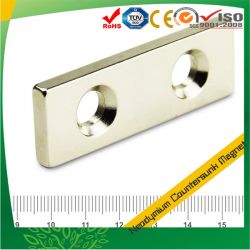
Magnetisation Grade: N48
Material: Neodymium-Iron-Boron (NdFeB), Neodymium and Steel
Magnet ID: NCB-703010-N48-Ni
Plating / Coating: Nickel (Ni-Cu-Ni) / Double Ni / Zinc (Zn) / Epoxy
Shape: Block with Countersunk (countersink)
Countersunk Magnet Size:
Block Total Long (L): 70 mm
Block Total Height (H): 30 mm
Block Total Width (W): 10 mm
Small Hole Diameter (d): 15 mm
Tolerance: ±0.05 mm
Magnetisation Direction: Axial / Radial
Residual Magnetic Flux Density (Br): 1380-1420 mT (13.8-14.2 kGs)
Energy Density (BH)max: 366-390 KJ/m³ (46-49 MGOe)
Coercivity Force (Hcb): ≥ 923 kA/m ( ≥ 11.6 kOe)
Intrinsic Coercivity Force (Hcj): ≥ 876 kA/m ( ≥ 12 kOe)
Maximum Operation Temperature: 80 °C
Delivery Time: 14-35 days
Pot magnets consists of magnet material enclosed in a metal 'pot'. The active magnet face is not enclosed.
The pot is an essential part of the magnetic circuit. The two magnetic poles are concentric and are both on the end face of the magnet.
Pot magnets are the most efficient design for gripping (other designs are preferable for lifting and attracting across air gaps).
1. Which is the strongest type of magnet?
Neodymium (more precisely Neodymium-Iron-Boron) magnets are the strongest permanent magnets in the world.
2. Is one pole stronger than the other?
No, both poles are equally strong.
3. What materials can I use to block/shield magnetic fields?
Magnetic fields cannot be blocked, only redirected. The only materials that will redirect magnetic fields are materials that are ferromagnetic (attracted to magnets), such as iron, steel (which contains iron), cobalt, and nickel. The degree of redirection is proportional to the permeability of the material. The most efficient shielding material is the 80 Nickel family, followed by the 50 Nickel family.
4. Can you supply monopole magnets?
No, we don't, nor does anyone else, because they don't exist. All magnets must have at least two poles.