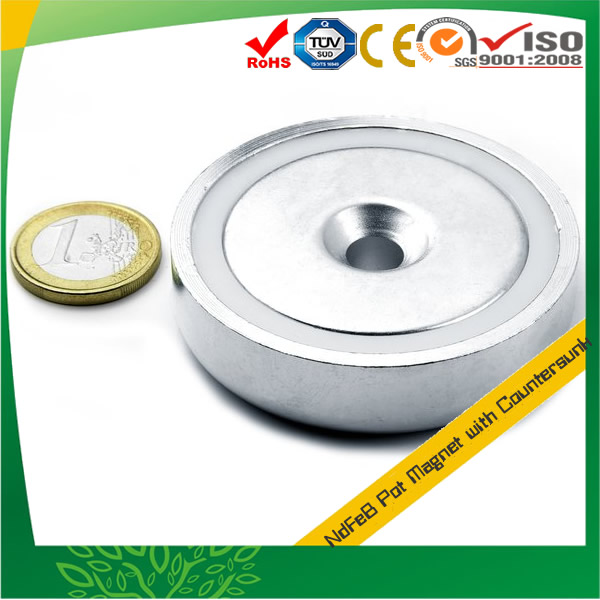
Magnetisation Grade: N42
Material: Neodymium-Iron-Boron (NdFeB), Neodymium and Steel
Magnet ID: NPC-60-N42-Ni
Plating / Coating: Nickel (Ni-Cu-Ni) / Double Ni
Shape: Ring / with Countersunk (Countersink)
Pot Magnet Size:
Pot Total Diameter (D): 60 mm
Pot Total Height (H): 15 mm
Borehole Top (d1): 8.5 mm
Borehole Bottom (d2): 18.12 mm
Countersunk Depth (h): 4.81 mm
Tolerance: ±0.1 mm
Magnetisation Direction: Axial
Residual Magnetic Flux Density (Br): 13.0-13.4 KGs (T): 1.30-1.34 T
Energy Density (BH)max: 40-43 MGOe 318-342 KJ/m³
Coercivity Force (Hcb): ≥10.8 KOe ≥860 KA/m
Intrinsic Coercivity Force (Hcj): ≥12 KOe ≥955 KA/m
Maximum Operation Temperature: 80 °C
Delivery Time: 14-35 days
Measurements:
The basic principle of the holding or pot magnet is to direct and concentrate the flux from both magnetic poles to one active face. This is usually achieved with steel pole pieces or a steel-backing cup.
The standard selection can be broken down into three material types and there is a great variety of systems available. The following data should act as a simple guide:
1) Sintered Ferrite, this material offers a good performance from an inexpensive magnet, however, they tend to be bulky and are not always suitable where space is an important factor. The steel parts are plated & the Ferrite is inert thus corrosion is limited. Maximum operating temperature is +120 degree Celsius.
2) Cast AlNiCo, offers a better holding force than Ferrite systems and is the only pot magnet that can be heated to extreme temperatures. However, the high cost of the Cobalt content in the cast magnet makes the price prohibitive unless the application requires temperatures over +120 degree Celsius up to a maximum of +500 degree Celsius .
3) Rare Earth Samarium & Neodymium, pots and assemblies can offer up to eleven times the performance of a Ferrite system in a comparable size. Applications tend to be specialized engineering projects where performance and available space are key factors. Maximum operating temperatures are +60 degree Celsius C for the Neodymium and +150 degree Celsius - +250 degree Celsius C for the Samarium depending on the design configuration.